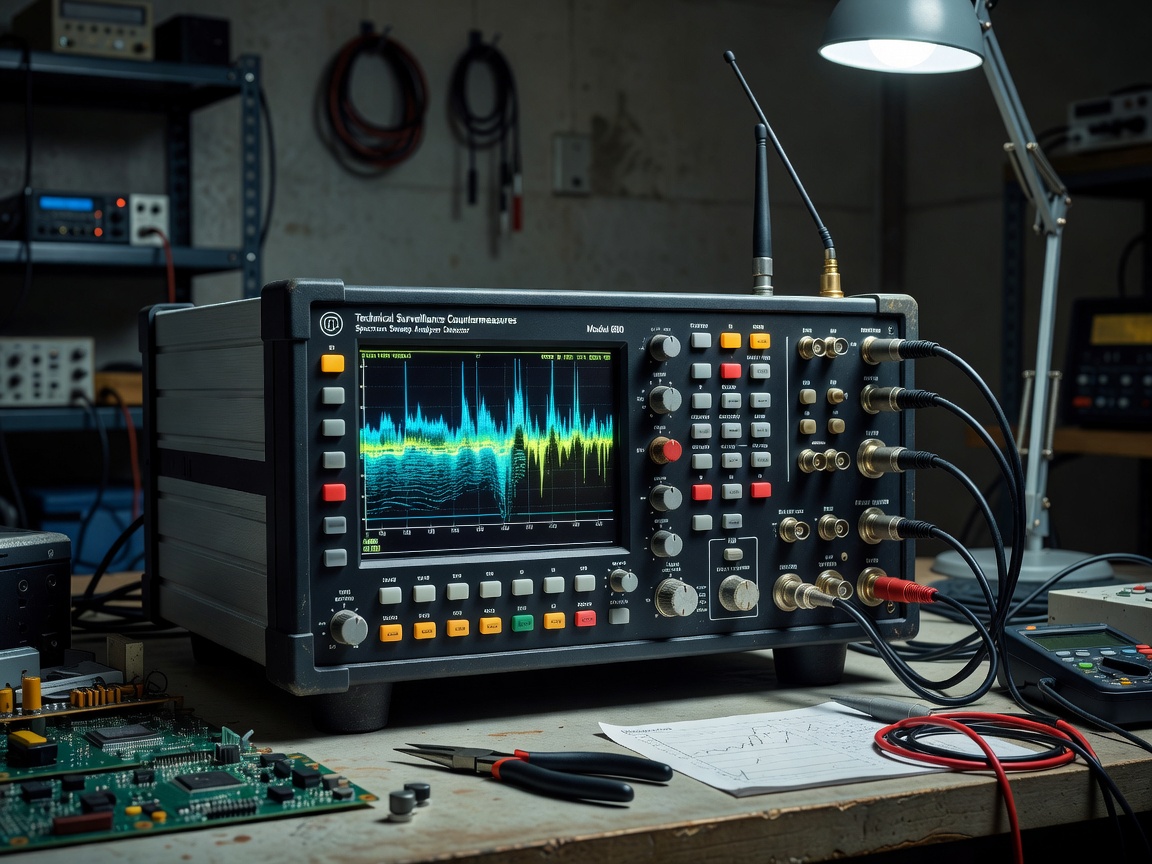
The Science of Eavesdropping Neutralization
Technical Surveillance Countermeasures (TSCM) encompasses the systematic physical, electronic, and optical examination of facilities to detect, locate, and neutralize unauthorized listening devices, hidden cameras, optical taps, and radio frequency beacons. While offensive espionage seeks ever smaller, more power-efficient microphones and covert transmitters, TSCM applies advanced physics to reveal the physical presence of eavesdropping hardware, regardless of whether it is actively broadcasting or lying dormant.
Effective TSCM is not a simple "sweep" with an handheld radio scanner. Modern covert devices utilize store-and-burst radio bursts, spread-spectrum hopping, carrier-current transmissions over ordinary 230V building power cabling, or passive resonant cavities that emit no radiation until excited by an external microwave beam.
Primary Diagnostic Instruments & Methodologies
A professional TSCM operational sweep combines multiple diagnostic technologies:
- Non-Linear Junction Detection (NLJD): Transmits a microwave carrier frequency (typically in the 2.4 GHz or 800 MHz bands) and listens for the returned harmonic responses. Solid-state semiconductors (silicon diodes, transistors) return a dominant second harmonic signal, whereas natural oxidized metals (rust, dissimilar metal junctions) return a dominant third harmonic. This enables operators to find hidden microelectronics embedded deep inside concrete walls, drywall, or wooden furniture even when unpowered.
- Broadband Real-Time Spectrum Analyzers (RTSA): Continuous sweep monitors that capture transient, burst, and frequency-hopping transmissions across the 10 kHz to 24 GHz spectrum, comparing current environmental RF signatures against baseline RF maps.
- Thermal Acoustic & Optical Inspection: High-resolution infrared thermography identifying microscopic heat signatures generated by hidden transformers, camera sensors, or battery regulators, accompanied by specialized optical lens finders that reflect off camera glass.
- Time-Domain Reflectometry (TDR): Injecting high-frequency electrical pulses down telephony, Ethernet, and electrical lines to detect minute impedance mismatches caused by inline inductive taps or parasitic splices.
Comparison: TSCM Diagnostic Hardware
| Instrument Type | Target Threat Profile | Detection Mechanism | Operational Limitations |
|---|---|---|---|
| Non-Linear Junction Detector | Concealed microphones, cameras, powered or unpowered chips. | 2nd vs. 3rd harmonic ratio identification from silicon p-n junctions. | Requires physical close-proximity scanning of every surface inch. |
| Real-Time Spectrum Analyzer | Active RF transmitters, Wi-Fi bridges, cellular implants. | Fast-Fourier transform (FFT) waterfall spectrum logging. | Cannot detect hardwired passive recording devices or dormant units. |
| Optical Lens Retro-Reflector | Pinhole camera lenses behind paintings, clocks, or vents. | Collimated laser reflection off spherical optical elements. | Line-of-sight required; false positives from reflective metallic flecks. |
| TEMPEST Field Probe | Compromising monitor/cable electromagnetic emanations. | Near-field magnetic and electric field antenna profiling. | Requires anechoic environment or complex RF background subtraction. |
Architecture of a Certified SCIF
When discussions involve high-value national security or trade secrets, routine sweeps are insufficient. Organizations construct Sensitive Compartmented Information Facilities (SCIFs)—hardened enclosures engineered from the ground up to prevent technical penetration:
- Faraday Cage Enclosure: Solid sheet-copper or galvanized steel wall, floor, and ceiling liners creating an unbroken electromagnetic shield that attenuates outgoing and incoming RF signals by 80dB to 120dB across critical bands.
- Acoustic Isolation: Sound Transmission Class (STC) 50 or higher architectural construction, incorporating double-stud isolated drywall, sound-dampening acoustic caulking, and vibration-isolated HVAC ductwork fitted with acoustic sound baffles.
- Acoustic White Noise Masking: Piezoelectric sound transducers mounted directly onto perimeter windows and structural walls, vibrating surfaces with random acoustic noise to defeat external laser microphones measuring glass micro-vibrations.
- Power and Telephony Filtering: Heavy-duty low-pass filters installed where electrical utility lines penetrate the perimeter, preventing carrier-current listening devices from pushing modulation along external wiring.
Operational Discipline: The Human Element in TSCM
No amount of architectural shielding protects against a compromised personal device brought inside. Modern TSCM doctrine strictly enforces "red-black" separation: red areas are completely sterile zones where no unauthorized mobile phones, smart watches, Bluetooth headphones, or wireless devices are permitted across the threshold.